
Per-Seat vs. Per-Workspace Pricing: Which Saves More?
Currently, agencies and project owners are increasingly relying on project management tools that handle the entire management process without human intervention. With the proliferation of project management tools, agency owners are often faced with the dilemma of choosing between a per-seat pricing vs. per-workspace pricing. To improve your operations, you can discover how to get paid fast or learn to reduce SaaS costs.
At the beginning of a project, a per-seat pricing model seems very logical. However, as teams expand, costs increase, leading many agency owners to seek reduced software spend. In addition, to boost efficiency, you may want to improve remote team collaboration or stop wasting time on manual reports.
In this guide, we will conduct a clear comparison between per-seat pricing vs. per-workspace pricing, providing agency owners with a clear understanding that will help them choose the best project management pricing models based on their desired expansion.
What Is Per-Seat Pricing?
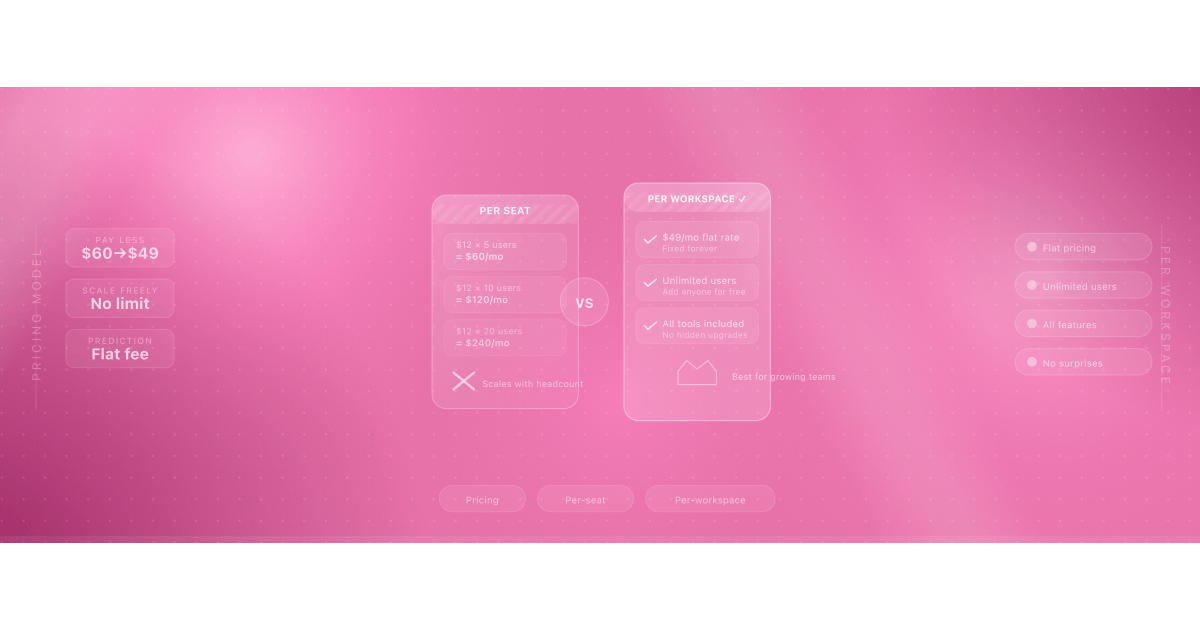
The Per-Seat Pricing model is very common in project management, and we will illustrate this with a practical example. If the tool's subscription fee is $10 per user, this means:
- 5 users = $50 per month
- 10 users = $100 per month
- 15 users = $150 per month
This means the invoice will gradually increase as each new user is added to the tool, according to the base subscription fee. This pricing model is ideal in the following situations:
- ✓ If you have a limited number of freelancers
- ✓ If you don't plan to add clients to the tool in the future
- ✓ If you have a small, stable team of employees
What Is Per-Workspace Pricing?
Workspace pricing is a fixed pricing model designed to cover the entire workspace without paying per employee. It's ideal, especially for teams looking to grow or expand in the future. To clarify, let's look at a practical example:
"The platform's monthly subscription fee is $100 for a workspace. This fee remains constant whether you have 5, 10, or 20 employees."
Per-Seat Pricing vs. Per-Workspace Pricing: Key Differences
When comparing per-seat pricing vs. per-workspace pricing, we find that the difference goes beyond pricing. To make the picture clearer for you, here is a table that includes the most prominent differences between per-seat pricing vs. per-workspace pricing:
| Aspect | Per-Seat Pricing | Per-Workspace Pricing |
|---|---|---|
| Pricing Model | Paid per user (seat) | Flat fee per workspace |
| Cost Behavior | Increases with each new user | Flat and predictable rate |
| Scaling | Becomes expensive as team grows | Scales easily without extra cost |
| Adding Freelancers | Adds extra cost per freelancer | No additional cost (Manage freelancers without extra seats) |
| Client Collaboration | Often limited due to cost | Easier and encouraged |
| Budget Predictability | Hard to predict | Fully predictable |
| Team Growth Impact | Slows down expansion decisions | Supports fast scaling |
Why Per-Seat Pricing Becomes Expensive as Teams Grow
At the beginning, per-seat pricing is very attractive, but as teams look to grow or expand, the cost increases. For example:
Per-Seat Pricing ($10/user)
- 5 users = $50 per month
- 10 users = $100 per month
- 15 users = $150 per month
The cost doubles as the team grows. At this stage, many agencies look for a Monday.com Alternative for Agencies.
Per-Workspace Pricing ($100/flat)
- 5 users = $100 per month
- 10 users = $100 per month
- 15 users = $100 per month
The cost remains constant as the team grows, making it ideal for agencies looking to expand in the future.
The Psychological Cost of Seat-Based Pricing Most Teams Ignore
It's not just about the amount of money agencies spend on seat-based pricing; it's about the pressure it creates within the workplace that many teams are unaware of. This pressure leads many agencies to lay off team members to reduce software spend.
The thinking in this case is primarily focused on minimizing and controlling costs rather than hiring experts who support the team and help companies scale.
Why Workspace Pricing Helps Small Teams Scale Faster
Workspace pricing helps teams scale better for the following reasons:
Easier Collaboration Without Extra Cost
Per-seat pricing puts more psychological pressure on business owners. In contrast, workspace pricing helps companies:
- ✓ Add more employees and freelancers without incurring additional expenses.
- ✓ Enable more clients to subscribe to tools.
- ✓ Make employee collaboration much smoother.
Better for Agencies and Contractor-Heavy Teams
For teams with large staffs or high freelance turnover, workspace pricing is better because:
- ✓ You can add a large number of freelancers without incurring any additional expenses.
- ✓ Collaboration between clients and employees becomes easier and more frequent.
Predictable SaaS Costs for Small Businesses
Small business owners appreciate predictable expenses. A fixed price means:
- ✓ A clearer, easy-to-manage budget.
- ✓ Fewer surprises and billing shocks.
- ✓ Easier long-term growth planning.
How Taskeya Eliminates Per-Seat Pricing Pain
Taskeya's concept is based primarily on the Workspace pricing, which reduces the burden of expenses for business owners in the future.
Unlimited Collaboration Without Seat Anxiety
There's no need to worry about user costs, as the cost remains fixed regardless of the number of your employees, whether it's 5, 10, or 20.
Lower Software Spend With One Workspace Price
Taskeya is an integrated project management tool that handles the management process from project registration to invoicing and monitoring workflow between employees, so you do not need other tools to help with project management.
Why Small Teams Choose Taskeya Over Traditional Tools
Small businesses are increasingly choosing Taskeya over other project management tools for the following reasons:
Why Teams Choose Taskeya
- Stop Paying for 6 Different Tools: Taskeya offers a clear pricing model that allows companies to scale and add more freelancers and employees without incurring additional costs or expenses.
- Frictionless Workflows: Having the entire team on a single tool enhances workflow and eliminates project handover errors.
- All-in-One Operations: A comprehensive tool that handles projects from registration to invoicing, eliminating the need for separate CRM and invoicing packages.
Who It's NOT For
- Teams looking for a simple checklist app without billing or client portal tools.
- Large enterprises (50+ users) needing deep customized legacy databases.
- Users looking for individual productivity tools without team workspace sharing.
Conclusion
When comparing between per-seat pricing vs. per-workspace pricing, the difference isn't solely based on price. Other contributing factors include the limited number of employees per person in the traditional per-seat pricing, which puts more pressure on agency owners and makes scaling more difficult. To get started, you can check our flexible pricing plans or explore our Taskeya solutions to see how we help teams unify their operations.
In contrast, the workspace pricing model gives teams greater flexibility in enhancing collaboration, and the cost of scaling remains constant even with the addition of more employees or freelancers. A platform like Taskeya is also integrated for project management, so there's no need to pay extra for subscriptions to other project management tools.
Frequently Asked Questions
What is the difference between per-seat pricing and per-workspace pricing?
Per-seat pricing charges per user, while per-workspace pricing is based on a fixed price for the entire workspace, regardless of the number of users.
Is workspace pricing cheaper for small businesses?
Often, yes, especially if the team is growing or working with collaborators and freelancers, as it reduces escalating costs.
Why do agencies prefer workspace pricing?
Because agencies are constantly adding members and clients, fixed pricing is more flexible and less expensive for them.
How can I reduce software spending as my team grows?
You can reduce spending by:
- Choosing the right workspace pricing model.
- Reducing the absolute number of tools used.
- Using platforms like Taskeya that consolidate CRM, projects, and invoicing in one place.
Is per-seat pricing bad for contractor-heavy teams?
Often yes, because each additional freelancer or collaborator increases the cost, making teams that rely on contractors pay too much.
Ready to Unify Your Agency Stack?
Start consolidating your projects, CRM pipeline, invoicing, and client-facing portals under a single, high-performance agency operating system today.
Read Next
Best Monday.com Alternative for Agencies Without Per-Seat Pricing
Discover why Taskeya is the best Monday.com alternative for agencies. Learn about flat-rate workspace models and all-in-one operations.
How Small Teams Reduce SaaS Costs Without Losing the Tools They Need
Learn how small teams reduce software spend by eliminating SaaS sprawl and switching to all-in-one software that cuts costs.